
Category: Uncategorized
Construction material supply and price issues
Construction material supply and price volatility is at record levels. It seems like every day we are being notified of forced significant changes in material price and significant delays on delivery.
Why is this happening?
Our federal counterparts, the Canadian Construction Association, explain that the current situation is a result of a perfect storm of factors, including:
1) The decision by the Quebec provincial government to shut down the province’s economy last March, including the supply and manufacturing industries, caused some companies (e.g. lumber) to sell their inventory to the US, particularly since economic activity in other provinces was also slowing down. This led to a shortage of materials into the fall of 2020 and seems to be continuing today .
2) COVID-19 brought new requirements to worksites and production lines, including social distancing, enhanced cleaning protocols, and limiting the number of people allowed on sites. These requirements, while necessary, had a huge impact on productivity which led to a reduction in materials produced well into the fall of 2020.
3) Under the Trump administration, the US industry did not slow down at all as no extraordinary measures were taken to reduce the spread of the virus, which accentuated the demand for Canadian products.
4) Prior to COVID-19 being declared a pandemic, the Port of Montreal was hit by a long strike that paralyzed the port for many weeks and massively disrupted the supply chain.
5) Softwood production continues to be disrupted in British Columbia and Alberta due to a pine beetle infestation since 2017.
6) During the first two waves of the pandemic, many Canadians chose to start their own personal home improvement projects, which increased demand for construction materials and again added to the supply crisis, leading to escalating costs.
How bad is it?
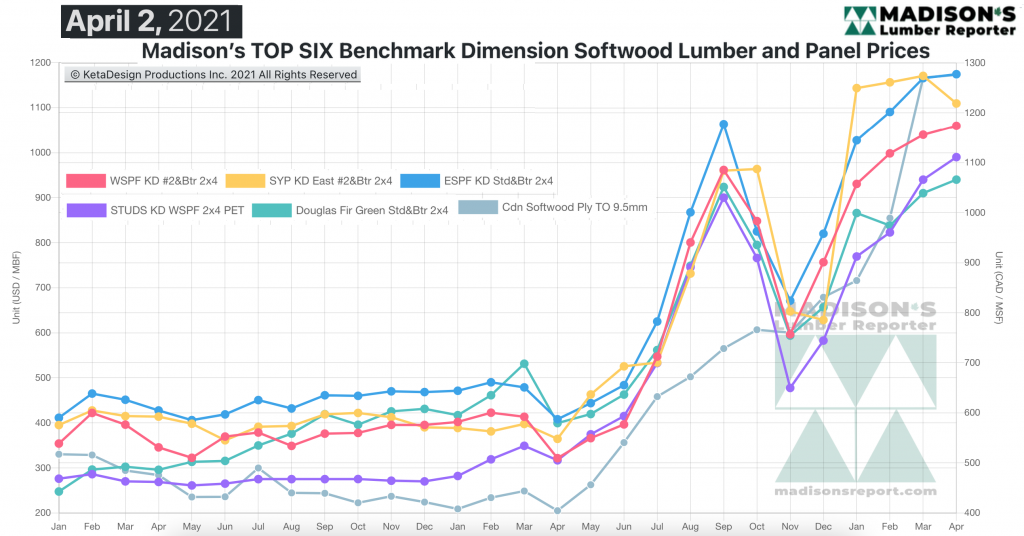
As you know, the result has been significant price increases for many fundamental building supplies and delays in shipping. Based on the most recent market update provided by Madison’s Lumber Reporter, the benchmark price for softwood lumber is triple that of the price in February of last year.
Madison’s also reports significant wait times for lumber deliveries. If you see lumber in a lumberyard, it most likely is already sold! Below is a graph outlining the price changes since January 2019. It clearly shows prices stability between January 2019 to March 2020, followed by significant price changes starting July of last year.
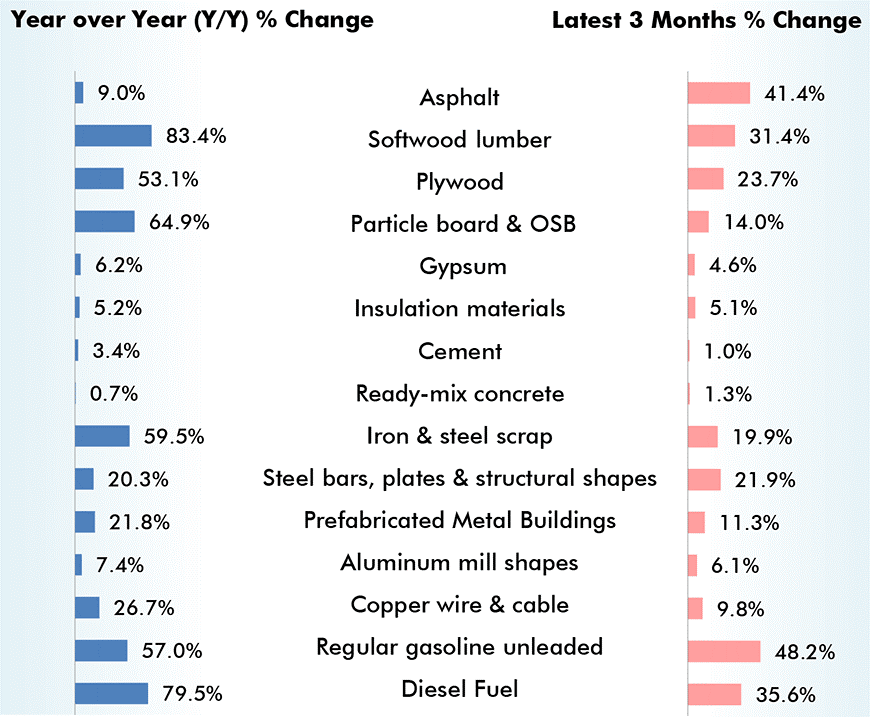
Lumber isn’t the only construction material experiencing price changes. Below is a graph based on the U.S. Producer Price Index as of March 2021. In addition of fuel and lumber, the significant movers have been iron and steel. The PPI is not reporting major changes in gypsum yet, but we are hearing reports of tight supply.
Table 1: U.S. Construction Material Cost Changes
From Producer Price Index (PPI) Series – March 2021
What can I do to protect myself and my business?
It’s impossible to be certain how long these price surges will last, but it’s reasonable to expect them to continue into 2022. While WCA doesn’t have a secret supplier of lumber or steel that can get you materials at a reasonable price, we can offer you something that will help – strategies on how to use construction contracts to mitigate the risk of rising prices and supply chain issues.
WCA is hosting a free information session on Using Contracts to Manage the Risk of Price Volatility on May 13 from 11:30 – 12:30. More information and registration (once again, this is a free session) available here.
The WCA Newsletter – April 16
The latest edition of The WCA Newsletter is now available here.
Bill 61 – The Apprenticeship and Certification Amendment Act
WCA recently provided feedback to the provincial government on Bill 61 – The Apprenticeship and Certification Amendment Act. You can read our submission to the government here.
Bill 13 – The Public Sector Construction Projects (Tendering) Act
WCA recently provided feedback to the provincial government on Bill 13 – The Public Sector Construction Projects (Tendering) Act. You can read our submission to the government here.
Bill 32 – The Election Financing Amendment and Elections Amendment Act
WCA recently provided feedback to the provincial government on Bill 32 – The Election Financing Amendment and Elections Amendment Act. You can read our submission to the government here.
The WCA Newsletter, April 1
The latest edition of The WCA Newsletter is now available here.
WCA Newsletter – March 19
The latest edition of The WCA Newsletter, featuring a story on the province considering removing the 14-day period for inter-provincial business travellers, is now available here.
Province Announces Changes to Apprenticeship Manitoba
On March 3, Minister Eichler provided the details of Bill 61: The Apprenticeship and Certification Amendment Act. These changes are in addition to recent changes made to apprenticeship programs such as the changes to ratios and gasfitter requirements.
Bill 61 will focus primarily on Apprenticeship Manitoba’s governance structure. A governance review conducted in 2017/18 provided a number of recommendations to make Apprenticeship Manitoba more responsive to changes in the relevant trades and occupations. Some of the changes include:
· A reduction of the Apprenticeship Board from 15 to 12 individuals.
· Require the preparation of a 5-year strategic plan.
· Creating sector-based committees which replace the Provincial Advisory Committees (PAC) which will meet regularly
· The Board will be empowered to create by-laws respecting voluntary trades and existing trade regulations will be repealed.
· The regulations for specific Compulsory trades will remain.
· Allows the Minister, not the Apprenticeship Board, to designate trades and occupations and establish apprenticeship programs for the compulsory certification trades.
WCA is broadly supportive of these changes, however the changes themselves do not address the fundamental governance issue which has been identified in numerous reviews: The Apprenticeship Branch does not report to the Apprenticeship Board as one would expect.
It will be important to make sure that the 12 Board members are engaged in the apprenticeship system as employers or worker representatives each having a current background in one of the apprentice-able trades.
Developing sector-based committees which meet regularly and have the opportunity to provide advise that is listened to is imperative and welcomed. The role of these committees should be to provide advise to the Apprenticeship Board on the views of the Industry regarding all changes to apprenticeship activities that impact their sector. It will be important that committee members represent broad cross-section of the industry.
The Bill will also repeal regulations for voluntary trades (46 of the 55 trades are voluntary) and replace those with bylaws created and amendable by the Apprenticeship and Certification Board. A reduction in regulations is undoubtedly a goal of government and may provide more flexibility and nimbleness for the voluntary trades.
The Bill does increase the power of the Minister to designate trades and occupations and establish apprenticeship programs for the compulsory certification trades. In general, removing a decision from a representative Board to give to the Minister may reduce the ability for the industry to have influence over a decision. This change should not be taken lightly and fully considered before it is implemented.
WCA Newsletter – March 5
The latest edition of The WCA Newsletter, including information on a free webinar explaining the new CCDC 2, is now available here.
Construction Materials Shortages
In recent months we’ve heard concerns from members over material shortages and price instability, likely resulting at least in part from the COVID-19 pandemic.
To help our members in this situation we’ve sent a letter to construction owners urging them to use early tender awards. We have seen 90-day award periods become normal, which makes it extremely difficult when certain commodity pricing is only good for 15 days. In our letter, we ask the owner community to award projects in 30 days or less.